
A community update from Virginia Pages
After our last update on the Virginia Bypass, a lot of people said the same thing: it feels like more of the same. Twenty plus years of waiting will do that. But part of the frustration comes from how little any of us are told about why a promised road takes so long. So rather than another "no start date yet" post, here's a plain-English look at how a project like this actually gets built - the stages it has to pass through, and the points where it can speed up or stall.
None of this is to defend the delays. It's just so we all know what we're actually waiting on.
It's not one decision - it's a series of gates
A national road doesn't get a single green light. It moves through a sequence of phases set out by Transport Infrastructure Ireland (TII), and it can't jump ahead, each stage has to be finished and approved before the next begins. The Virginia Bypass is currently in Phase 3: Design and Environmental Evaluation, which the Minister said in June is approaching completion.
Here's the rough journey, and where we are on it.
1. Design and environmental work (where we are now). Engineers settle the exact route, the junctions, the land needed, and assess the environmental impact. This is the phase finishing up now. It's slow partly because of the detail involved and partly because the rules it has to satisfy - environmental law, active travel guidelines, assessment requirements have changed over the years, which was one reason given for the recent delays.
2. The Preliminary Business Case (the live next step). Before the State commits serious money, the project has to prove its case on paper - costs, benefits, safety, value for money. Cavan County Council is expected to submit this to TII this summer. It then needs what's called "Gate 1" approval under the Government's Infrastructure Guidelines. This is the immediate hurdle the bypass faces.
3. Planning. If the business case is approved, the project goes to An Coimisiún Pleanála (the body formerly known as An Bord Pleanála) for formal planning permission. This is where the public and affected landowners get a formal say. Councillors were told earlier this year that this stage isn't expected before the last quarter of 2027 at the earliest.
4. Land and detailed design. After planning, the land has to be legally acquired and the road designed in full construction detail. Acquiring land can itself take time.
5. Funding to build, then construction. Finally, the money to actually build it has to be confirmed which is why being included in the National Development Plan matters, before it goes to tender and construction begins.
Where it speeds up, and where it slows
Looking at that list, you can see why "no exact start date" is the honest answer rather than a dodge. The things that move a project like this forward are mostly invisible from the outside: a phase being signed off, a business case being approved, funding being confirmed in a budget. The things that slow it down are the same gates stalling, an approval taking longer than hoped, rules changing mid-process, or money not being confirmed for the next stage.
Right now, the single most important thing to watch is whether that Preliminary Business Case is submitted this summer as expected, and whether it gets Gate 1 approval. That's the gate the whole timeline currently hinges on. The planning stage, land acquisition and construction funding are all real hurdles still to come but they only matter once this one is cleared.
.
So what does that mean for us?
It means the project genuinely is moving, even if it doesn't feel like it — but it's moving through a process built for caution, not speed, and every stage is a place it can sit for months. The "false dawns" people remember are mostly moments when one stage was expected to finish and didn't.
Knowing that, the question worth asking isn't just "when will it start" — it's how a town keeps a project like this visible and on track through years of quiet, behind-the-scenes stages.
This is a community information piece from Virginia Pages, the local platform for Virginia, Co. Cavan, based on publicly reported updates from Cavan County Council, Transport Infrastructure Ireland and the Minister for Transport, as of June 2026. Timelines are subject to change. For the full story, see the coverage in The Anglo-Celt.
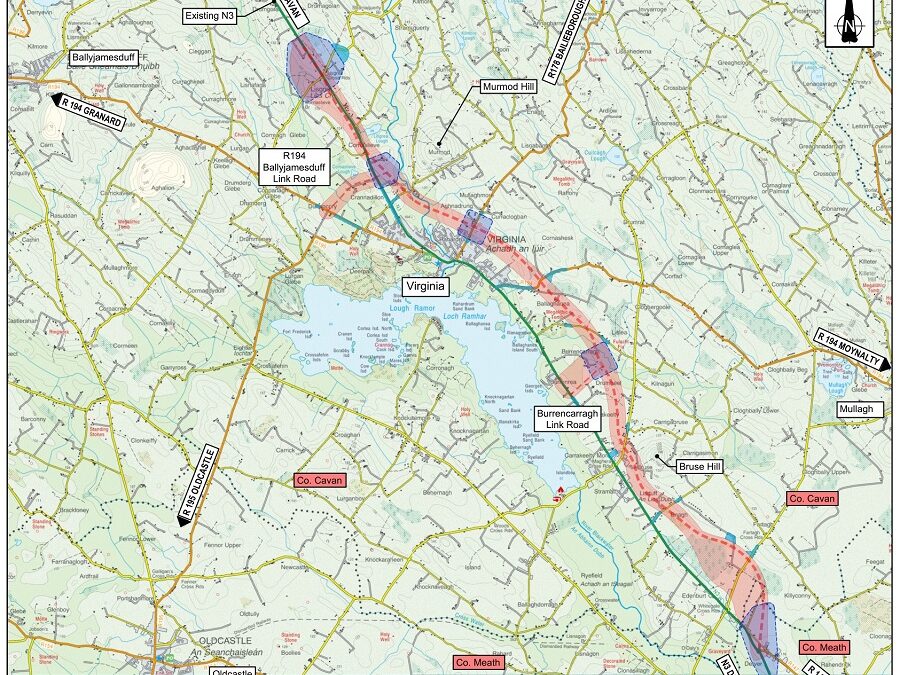
Route map: N3 Virginia Bypass scheme, Cavan County Council / Transport Infrastructure Ireland. Source: n3virginiabypass.ie