
Life After the Bypass: What Do We Want Virginia to Be?
A community update from Virginia Pages
Yesterday, Northern Sound broadcast The Wider View with Ronan Gargan live from Virginia's main street, and the subject was the one that never really goes away: the bypass. Councillors, gardaí, business voices and residents all had their say. If there was a single feeling running through it, it was frustration edging into helplessness, the sense of a town that has asked, and waited, and been given date after date, only to watch the plans change and the clock reset again.
That feeling is understandable, and it's worth naming honestly rather than glossing over. But it's also worth being clear about where it comes from because once you see that clearly, there's a more hopeful conversation waiting underneath it.
The part we don't control and the part we do
The timing of the bypass is not in Virginia's hands. Because the main street is the N3, a national primary road, the decision on when and how it gets bypassed rests with Transport Infrastructure Ireland, driven by national priorities and a long statutory process. That's exactly why local representatives can keep asking and still not deliver a firm date, it isn't theirs to give. Hence the helplessness.
But there's a second question, and this one is ours: what does Virginia become once the bypass arrives? What happens to the main street when the through-traffic is gone? That outcome isn't decided in Dublin. It's decided here by the town, its businesses, and its community. And it's a question worth starting to think about now, long before the diggers arrive, so that when the day comes Virginia isn't starting from a blank page.
"You'll get your town back"
There's a worry that often surfaces around bypasses that taking the traffic away might take the trade with it. It's a fair concern, and it deserves a real answer rather than reassurance. So here's what actually happened in other Irish towns, including the ones just down the very same road.
Dunshaughlin, Navan and Kells all on the N3 were bypassed when the M3 opened in 2010, after decades as some of the worst bottlenecks in the country. At the time, the promise made to those towns was simple: you'll get your town back. And broadly, they did. None of them hollowed out. As commuter-belt towns, they kept growing, because people had reasons to live in them and return to them.
Kells is the most instructive, because it shows the bypass as the start of the work, not the end. Even with the M3 taking the through-traffic, the town still had congestion, parking and footpath issues to sort which is exactly why it now has a public realm and regeneration plan, and why new development there is being built as an extension of the existing town centre rather than a rival on the edge. The bypass freed the town up; the town then chose to invest in itself.
The pattern repeats elsewhere. When Macroom in Co. Cork was bypassed, a formal study found around 40% of traffic including hundreds of heavy goods vehicles a day taken out of the centre, with cleaner air, less noise, and town-centre footfall actually rising by roughly a quarter. Shopkeepers spoke of customers returning who hadn't been in for years, and of being able to park again. In Moate, Co. Westmeath, a local butcher described deliveries that once took an hour to get across town now taking minutes and his footfall going up, as calmer streets drew more custom from surrounding villages.
It isn't automatic
It's only fair to show the other side. When the motorway opened past Abbeyleix in Co. Laois, roadside businesses that lived purely on passing trade were hit hard, and the passing tourist trade all but vanished. The towns that struggled were often the ones that did nothing to adapt and one lesson rang out above all: signage. If people on the new road can't easily find the town, or have no reason to turn off, they won't.
That's the whole point. When you can no longer rely on being the road people happen to be on, you have to be the place people choose to come to. The towns that thrived treated the bypass as a beginning: they got the signage right, invested in the town centre itself footpaths, trees, public space, the look and feel made parking and access easy, and leaned into the things a roadside stop can never offer: local character, food, events, independent businesses, a reason to linger.
Virginia has strong cards to play here a lakeshore, a growing and diverse population, and a real independent business community. The recent regeneration and pavement scheme in the town centre is already a step in that direction. The question is how the town builds on it when the bypass finally takes the pressure off.
So, over to Virginia
What came through the radio yesterday was a town that cares deeply and feels it has no levers to pull. On the timing, that's largely true. But on the future on what Virginia becomes next the levers are very much local, and there's clearly appetite in the town to shape its own path.
So maybe the most useful thing we can do, while we wait, is to start picturing it:
If the through-traffic were gone tomorrow, what would you want Virginia's main street to be? What would make you spend more time there as a resident, as a shopper, as a business? And for anyone who knows Kells, Navan or Dunshaughlin since the M3 what did those towns get right, or wrong?
Have your say below. The bypass may not be ours to schedule but what comes after it is ours to imagine, and ours to get ready for.
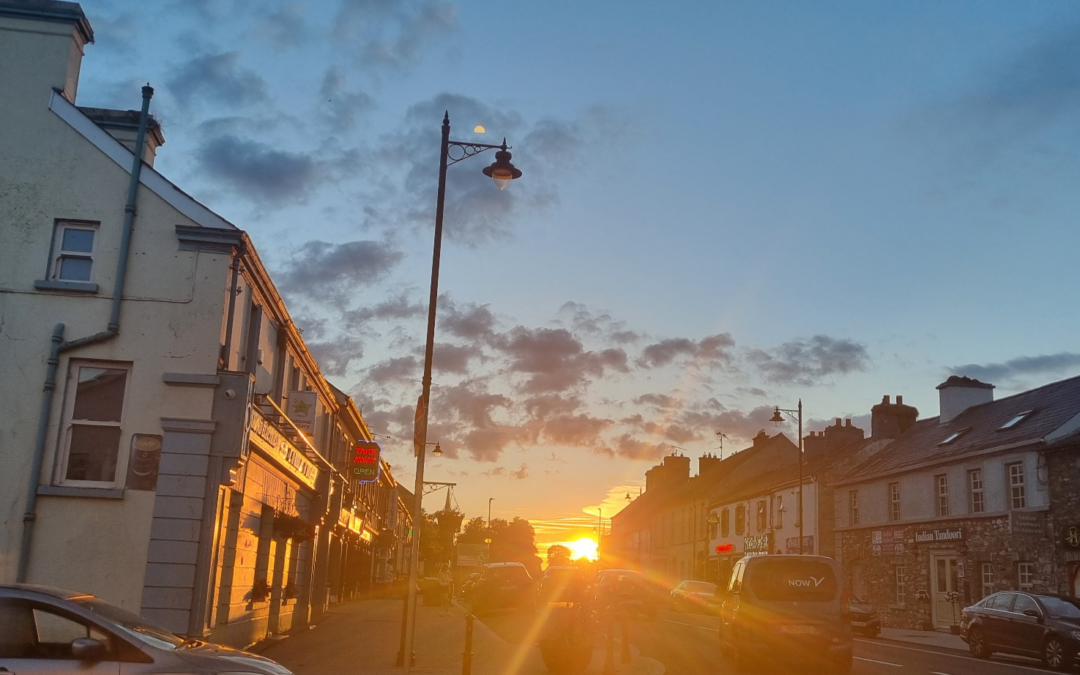
Featured image: sunset on Virginia's main street. Photo: Marion Clancy, shared with kind permission.
This is a community information piece from Virginia Pages, the local platform for Virginia, Co. Cavan. It draws on publicly reported coverage and impact studies of bypasses on the N3/M3 corridor and in Macroom, Moate and Abbeyleix. Examples from other towns are offered for context; every town is different.